

VHHs: Essential Building Blocks for Next Generation Therapeutics.

What is a VHH Antibody?

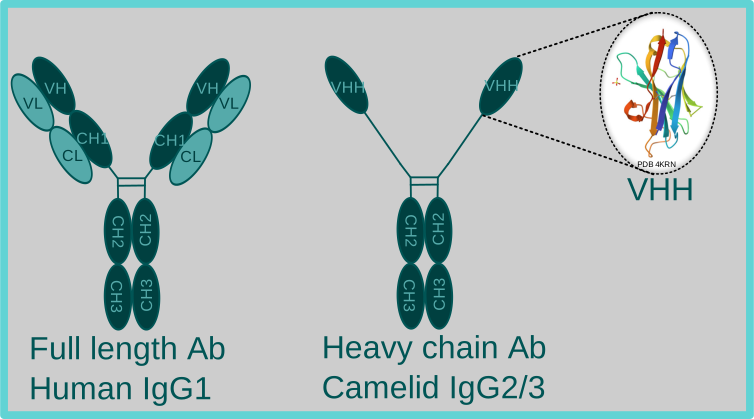
Heavy chain antibodies are a unique type of single domain antibodies (sdAbs) found in camelids (camels, llamas, and alpacas). The antigen binding region (paratope) of heavy-chain antibodies is solely formed by a single variable domain called VHH or Nanobody®. The small size (15 kDa) and stable fold of VHH domains have led to the use of VHH domains in diagnostic and imaging studies. Moreover, they serve as crucial building blocks in a variety of pre-clinically and clinically investigated bivalent, multivalent, and multi-specific antibodies in therapeutic areas like oncology, autoimmunity, and infectious diseases.

Who Turned Off the Light(chain)s?

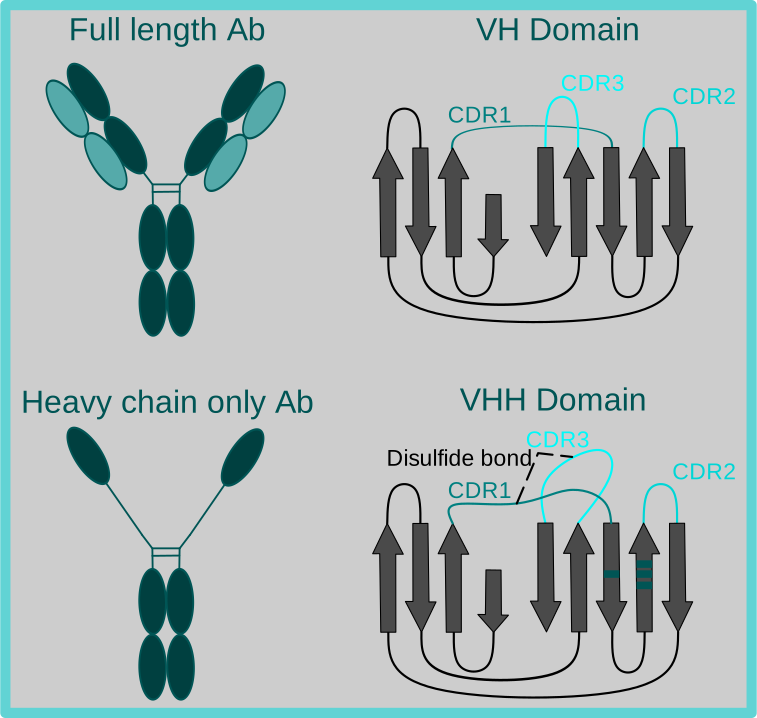
Key differences in human and camelid VH domains allow camelid VHH to act in the absence of a paired light chain. Among these differences are longer complementarity determining region H3 (CDR-H3) loops, substitutions in the framework 2 (FWR2) region, which is responsible for heavy–light chain pairing in conventional heavy chain (HC)/light chain (LC) antibodies, and non-canonical disulfide bonds. The FWR2 substitutions, also referred to as ‘hallmark residues’, consist of changes from hydrophobic to more hydrophilic residues, which lead to a more soluble interface in the absence of the light chain. The unique structural and biophysical properties of VHH further their utility and ability to translate to therapeutic applications. These advantages include:

Therapeutic Applications.

VHHs are being explored so extensively because of their ease of engineering and amenability to next generation therapeutics. Common applications of VHHs include:
Each therapeutic modality requires its own set of unique parameters. Abkyu offer contract research services for VHH discovery that are custom built for these specific therapeutic applications.

Clinical Successes of VHH Antibodies.

Despite only being discovered about 25 years ago, VHHs have garnered increasing attention due to their unique properties such as smaller size, increased stability, and ease of production compared to traditional antibodies. Several VHH-based drugs have reached clinical approval, primarily in oncology and immunology including:

The field is still expanding, with many VHH-based drugs in various stages of clinical trials. The success of these therapies indicates that we are likely to see even more VHH-based biologic drugs approved in the future.